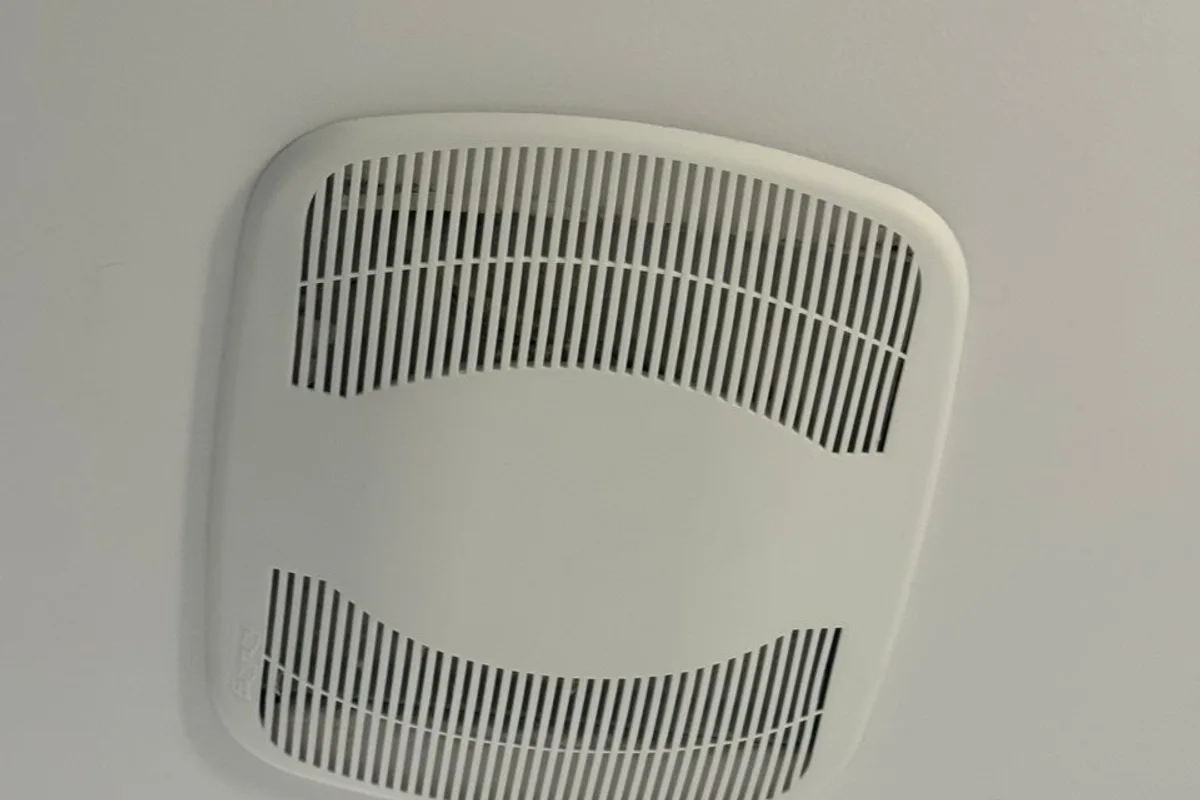
Switch the fan's circuit off at the breaker, pull down the cover and wash it in warm water with a little dish soap. Then vacuum the inside with a brush attachment and wipe the housing with a damp cloth. The blower and motor get vacuumed and wiped, never soaked, and nothing goes back on until every part is dry. That is the whole job on most fans, and it takes less time than the steam it clears.
Check it before you climb
A fan can hum along for years and move very little air. Two quick checks tell you whether yours needs attention, and both come from the clean bath fan guide of the US Department of Energy's Building America Solution Center.
- Look up at the cover with a flashlight. If you can see a layer of grey fluff in the slots, the guide says it's time to clean.
- Turn the fan on and hold a square of toilet paper or a tissue just under the cover. A fan that's pulling air holds it against the grille. If the paper drops, the fan is either clogged or not pulling at all.
Do the tissue check again when you're finished. If the paper still falls after a full clean, the problem is further up, in the duct or in the motor itself, and cleaning won't solve it.
Five parts, five ways to clean them
A bathroom fan is a few separate pieces stacked in a box in the ceiling, and they don't all take water the same way. This is the order you meet them in, from the room up.
| Part | What builds up there | How it gets cleaned |
|---|---|---|
| Cover (grille) | Dust stuck to a film of steam and hairspray | Vacuumed, then soaked and washed in mild soapy water, dried with a soft cloth |
| Housing (the metal box) | Loose dust, sometimes dark spots near the edges | Vacuumed with a brush attachment, wiped with a damp cloth |
| Blower wheel and motor | Felted dust on the blades or fins | Unplugged, vacuumed gently, wiped with a barely damp cloth. Never put in water |
| Light, on a fan that has one | Dust and dead insects in the lens | Unplugged inside the fan, lens washed on its own, fixture wiped only |
| Damper and duct | Lint where the duct leaves the box | What you can reach with the vacuum. Beyond that is a job for a ventilation company |
Power off at the panel, not the wall switch
The switch on the wall only stops the fan from running. It doesn't stop current from reaching the wiring you'll have your hands next to. Broan, a maker of bathroom fans, puts this at the top of the warnings in its user manual for the model 784 ceiling ventilator:
Before servicing or cleaning unit, switch power off at service panel and lock the service disconnecting means to prevent power from being switched on accidentally.
In a house that usually means finding the breaker marked for the bathroom and telling everyone at home not to touch the panel. If the breakers aren't labelled, switch the fan on, then try breakers until it stops.
The cover, step by step
- Put a towel on the floor or the tub under the fan, and dry the floor first if you'll be standing on a step stool over tile.
- Vacuum the cover in place with the brush attachment. Most of the dust comes off now instead of falling on you.
- Pull the cover straight down a few centimetres. Most are held by two wire springs on the sides: squeeze them together and the cover comes free. Some are held by a centre screw.
- If a wire runs from the cover to the box, stop. That cover holds a light, and the next section is for you.
- Fill the sink with warm water and a few drops of dishwashing liquid. Let the cover soak for a few minutes, then go over the slots with a soft brush or cloth.
- Rinse, shake off the water and leave the cover on a towel to air dry, or dry it with a soft cloth, as Broan's manual asks. Skip abrasive pads, steel wool and scouring powder on it.
Leave it to dry fully before it goes back up. A cover put back wet drips onto the floor and catches fresh dust in the slots.
Behind the cover
A fan that plugs into the box
On many fans, the motor plugs into a small socket inside the housing. Broan's manual says to unplug the fan assembly, then vacuum the fan, the motor and the inside of the housing gently. The Building America guide goes one step further and has you unscrew the motor from the housing, with a magnetic screwdriver so the screws don't drop, then clean the blades and wipe the housing and the motor cover with a damp cloth. Taking the motor out is optional. If the screws are rusted or the motor sits tight, vacuuming it in place with a soft brush gets most of the dust.
A damp cloth means wrung out until it barely leaves a mark. Any dark spots on the inside of the housing can be wiped the same way; if they keep coming back on the ceiling around the fan, the bathroom is staying too wet, which is the subject of the last section.
A fan with a light
The Building America guide says to unplug the light fixture before cleaning it and to unplug the fan as well while you work. Take the bulb out, wash the glass or plastic lens on its own the same way as a plain cover, and only wipe the fixture part. If the wiring is connected with wire nuts instead of a plug, leave the fixture in place and clean around it.
What stays off a bathroom fan
Several popular tips online clash with what the maker wrote. These are the ones worth skipping:
- Soaking the blower wheel or the motor. Broan's manual is plain that metal and electrical parts should never be immersed in water.
- Oiling a noisy motor. The same manual says the motor is permanently lubricated and never needs oil. If the bearings grind or whine, Broan's answer is to replace the blower assembly, which is a job for whoever services the fan.
- Spraying cleaner up into the housing. Spray the cloth instead, so no liquid reaches the motor and the wiring.
- Abrasive pads, steel wool or scouring powder, on any part.
- Mixing products to get rid of dark spots. Health Canada says to never mix bleach with any other cleaning product, because it reacts with ammonia and with acids, vinegar included, and gives off toxic gas.
Keeping the bathroom dry between cleanings
A clean fan only helps if it runs long enough. Health Canada's page on preventing mould at home asks for three things: use the bathroom fan while you shower, let it run for a few minutes after you're done, and make sure it vents to the outdoors, not into the attic. It also gives a target for the whole home, relative humidity between 30% and 50%, and suggests an inexpensive hygrometer from a hardware store to check it.
From November to March the effect of a weak fan shows up in other places first: water running down the inside of the window in the morning and black spots on the sill, which our article on window sill mould and condensation goes through, or grout around the tub that darkens again a week after it was scrubbed, covered in cleaning shower grout without damaging it. If those keep coming back, do the tissue check on the fan before anything else.
The fan cover is part of our bathroom deep cleaning, next to the tiles, grout and fixtures. If you'd like it done with the rest of the room, mention the fan when you ask for a quote.