
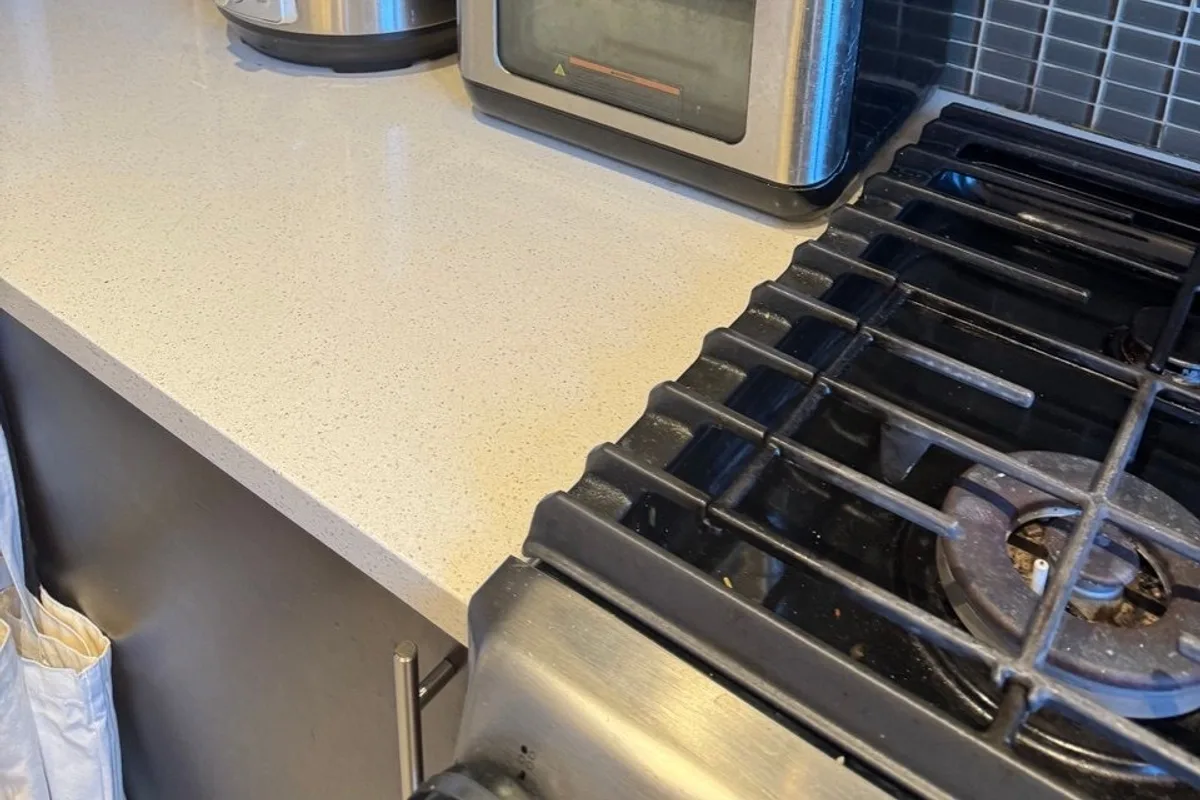
Warm water with a few drops of mild dish soap, a soft cloth, a rinse and a dry towel: that's the one routine quartz, granite and marble all take without complaint. Past that point the three stones want different things. Acidic cleaners and vinegar can harm granite and eat into marble, while the people who make quartz counters put cleaners sold for granite and marble on their own list of products to avoid. So before you buy a special spray, find out which counter you have.
Why one bottle doesn't suit all three
They look alike from across the kitchen, but they're built from different things.
- Quartz is a manufactured slab. Iowa State University's extension service describes it in its guide to stone countertop care as quartz stone held together with a synthetic polymer, and says it never needs sealing. The binder is the part that strong chemicals and heat can hurt.
- Granite is natural stone that gets sealed. The same guide warns that acidic cleaners like lemon juice, ammonia and window cleaners may damage it.
- Marble is mostly calcite. The US Geological Survey's page on acid rain and building stone explains that calcite dissolves easily in acid, which is why a splash of lemon or vinegar leaves a dull spot on a marble counter that no amount of wiping brings back.
Caesarstone, one of the big quartz makers, lists what to keep off its surfaces on its care and maintenance page. Oven and grill cleaners, dishwasher detergent, floor strippers, oil soaps, toilet bowl cleaners, drain products and wipes are on it. So are cleaners made specifically for granite, marble and other natural stone.
The cupboard check
Most kitchens already have these products under the sink. Each row is checked against the makers and the extension guide.
| In your cupboard | Quartz | Granite and marble |
|---|---|---|
| Dish soap in warm water | Yes, for everyday cleaning | Yes, and for marble it's the only cleaner the Iowa State guide names |
| Vinegar or lemon juice | No. Caesarstone says to avoid strong acids | No. Acid can damage granite and dissolves the calcite in marble |
| Glass or window cleaner | Iowa State says it won't damage quartz; Caesarstone asks you to test any product on a hidden spot first | No on granite, according to the same guide |
| Granite and stone sprays | No. They're on Caesarstone's list of products to avoid | Made for these, so follow the label |
| Cleaning wipes | No. Also on Caesarstone's list | Check the maker of your counter before using them |
| Bleach | Avoid, say Iowa State and Caesarstone | Avoid, says Iowa State |
| Oven cleaner, drain cleaner | No, never on the counter | No |
| Scouring pad or steel wool | No. Use a soft cloth or a non-abrasive scourer | No |
If something from the no column does land on a quartz counter, Caesarstone's advice is to rinse it off with water straight away.
A word about bleach
A lot of people reach for bleach after raw chicken. On these counters, soap and water does the cleaning. If bleach is used anywhere in the kitchen, never mix it with another product. Health Canada warns that bleach reacts with any cleaner containing ammonia or an acid, including vinegar, and the gas it gives off can burn your eyes and lungs. Glass cleaners often contain ammonia, so a spray of window cleaner after a bleach wipe is exactly the mix to avoid.
Tonight's wipe-down, in order
- Clear the counter. The kettle and the toaster go to one side so you clean the whole surface and not just the open patches.
- Brush crumbs into your hand or a dustpan before anything gets wet.
- Use a cloth that isn't your dish cloth. Caesarstone points out that the one you wash dishes with can carry grease back onto the counter.
- Wring it out in warm water with a little dish soap and wipe from the back wall towards you.
- Rinse the cloth in plain water and go over the counter again, so no soap film is left to dull it.
- Dry it with a soft towel. Water left to dry on a dark counter can leave marks from the minerals in it, the same way it does on a glass shower door in hard water.
- Put things back, and keep a cutting board out for the next meal. Caesarstone asks you to always cut on a board.
Is the sealer on your granite still working?
Sealer is what keeps oil and wine from soaking into granite and marble. It wears off, and the Iowa State guide gives a simple way to check it.
- Put a few drops of water on the counter in a spot you use a lot, next to the sink or the stove.
- If the water beads up on the surface, the sealer is still doing its job.
- If the water doesn't bead and the stone around it darkens, it's time to reseal with a stone sealer, following the product's directions. For a kitchen counter, choose one that's non-toxic.
The guide suggests checking marble every couple of months in the same way. Quartz skips this step entirely, because it isn't sealed.
Dried-on spills, marks and heat
Dried sauce or coffee on quartz shouldn't be scraped dry. Caesarstone's advice is to lay water on it for several minutes so it softens first, then rub gently with a soft cloth and a mild cleaner in circles over an area a little bigger than the mark. Repeat if it's still there.
Honed, matte and concrete-look quartz shows fingerprints, grey metal marks from pots and every drip far more than a polished slab. The maker says those finishes simply need cleaning more often, still with non-abrasive products.
Heat is the other way counters get damaged. Caesarstone asks for hot pots on a trivet or a hot pad, and the Iowa State guide says hot pans set straight on quartz can damage it. A roasting pan fresh out of the oven belongs on the stovetop or a board.
Grease that settles on the counter next to the range usually comes from the hood above it. If a sticky film keeps coming back, our article on cleaning range hood filters deals with the source.
If you don't know what your counter is
Look for the paperwork from your builder or the kitchen company, which usually names the material and often the maker. Until you know, clean it as if it were marble: soap, water, a soft cloth and nothing acidic. That routine is safe on all three.
Counters are wiped around the kettle and the toaster, and the backsplash tile by tile, in our kitchen deep cleaning. If it's the whole house you'd like off your list, have a look at regular home cleaning.