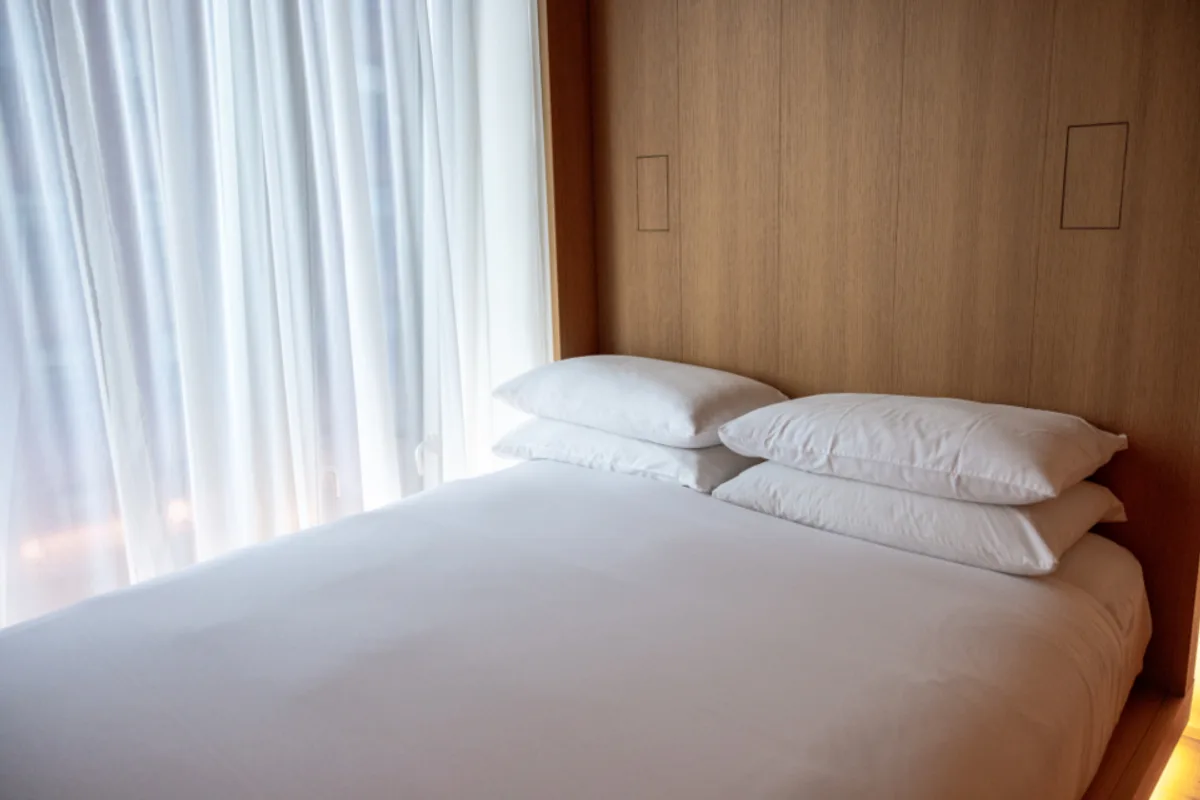
Most mattresses are cleaned the way their maker says, and for a foam mattress that means the inside never gets wet. You blot a spill, wash the cover only if its own tag says it comes off and can be washed, spot clean a cover that doesn't come off with as little liquid as you can, and let a fan finish the drying. The sprays, pastes and steam you see in so many online guides put far more water into a bed than a maker allows.
That's worth knowing before the next spill, because a mattress is not a sofa cushion you can take apart. Whatever soaks past the cover stays inside the foam.
The rules are on the tag and on the maker's page
Look for the tags sewn into the cover, usually along a side or at the foot of the bed. They tell you whether the cover zips off, whether it can go in a washer, and at what temperature. If the tag is gone, the maker's website usually has a care page under the model name.
Tempur-Pedic is a good example because it writes its rules plainly. Its help article on spills says a removable, washable cover goes in the machine in cold water with a mild detergent, and a cover that isn't removable is spot cleaned gently without saturating it. Then it adds a line that should change how you think about every recipe online:
TEMPUR-Material™ should never be soaked, washed, or allowed to become wet.
The same company's product care page goes further. It says not to use chlorine products or harsh stain removers of any kind on the cover, and admits that because the mattress should never get wet, it can't promise a spill will come out completely. Other makers word it differently. Your own tag is the rule for your bed.
Five popular tips, checked against the maker
Spray the stain with peroxide and dish soap
This is the most common recipe on cleaning blogs and mattress store pages, usually with instructions to spray it on, wait 10 to 15 minutes and blot. Every spray adds liquid, and on a fixed cover that liquid has nowhere to go but down into the comfort layer. If you try any cleaner at all, put it on a cloth, not on the bed, test it on a hidden corner first, and stop the moment the fabric feels damp rather than just touched.
Steam it to freshen it up
Steam is water. A steamer pushes hot moisture into fabric, which is exactly what a foam maker tells you to avoid. Even the guides that recommend it for spring mattresses say the bed has to dry completely afterwards. In a closed bedroom in late fall, that can take a long time, and you sleep on whatever is still damp.
Leave baking soda on it for hours
Baking soda sprinkled on a dry mattress and vacuumed off later is harmless and can take the edge off a smell. It doesn't lift a stain, and it doesn't clean anything under the cover. If you use it, wait until the mattress is completely dry first, and vacuum slowly along the seams, where the powder settles.
Mix two products to make it stronger
Some guides list vinegar, hydrogen peroxide and oxygen stain removers side by side, and people end up combining them. Don't. Health Canada's page on household chemical safety says never to mix household chemical products, because some mixtures produce harmful gases, and it warns specifically that bleach with ammonia or with an acid such as vinegar gives off toxic gas. A bed is the last place you want that. One product, on a cloth, then plain water on a second cloth to take it back out.
Flip it every season
Older two-sided mattresses were made to be flipped. Many newer ones are built with one sleeping side. Tempur-Pedic says its one-sided design means you never flip, rotate or turn it. Others ask you to rotate head to foot. Check the tag or the manual before you wrestle a queen bed off the frame.
If something spilled tonight
Work in this order. It comes from what the maker's spill instructions ask for and from the warnings above.
| What happened | What to do |
|---|---|
| Water, juice or tea, cover zips off and the tag says washable | Take the cover off, wash it cold with a mild detergent, then press towels into the wet spot on the mattress and run a fan across it |
| Same spill, cover is fixed | Blot by pressing, not rubbing, until a dry towel comes up dry, then spot clean the mark lightly with a damp cloth and run a fan |
| A child's or a pet's accident | Strip the bed, press towels in hard and change them as they fill, then dry with a fan before anything goes back on |
| An old yellow mark nobody remembers | Leave it dry. A stain that has set for months is not worth soaking the foam for |
| You already sprayed it and it feels wet | Stop adding product, press towels in, and keep the bed uncovered until the spot is dry to the touch and has no cool feeling |
If you're not sure the inside is dry, wait another night. Putting a fitted sheet and a duvet back on a damp patch traps the moisture.
The weekly part that keeps a bed clean
Spills are occasional. Dust mites are not. The Nova Scotia 811 page on dust mites, reviewed by the province's clinical services group, says most of the dust mites in a house live in the mattress, and that their waste is a major cause of allergies and asthma. Its advice for the bedroom is practical:
- Put a tightly woven, dust-proof cover over the mattress. The fitted sheet goes over it.
- Wash sheets and blankets every week in water of 54.4 to 60°C (130 to 140°F), and dry them completely on high heat.
- Be careful with that temperature at home: the same page warns that tap water over 48.9°C (120°F) can burn a child who turns the hot water on alone, and suggests a commercial laundry if you don't want your water heater set that high.
- Wash the pillow every week, or give it a dust-proof cover under the pillowcase.
- Vacuum carpets, upholstery and curtains weekly with a high-efficiency filter, and keep the humidity down with a dehumidifier.
A washable protector also catches what would otherwise reach the cover, and washing a protector is a lot easier than drying foam. Just check your mattress maker's view first: Tempur-Pedic, for one, asks owners to use a protector designed for its beds.
When to hand it over
We clean mattresses in your home, for your own bed, a guest room, or a rental between tenants. Send the bed size and a photo of the marks through our window, upholstery and mattress cleaning page and we'll reply with an estimate. If the sofa has its own story, our article on reading the cleaning code on a sofa tag covers the fabric side, and a rental being emptied is usually part of a move-out clean.